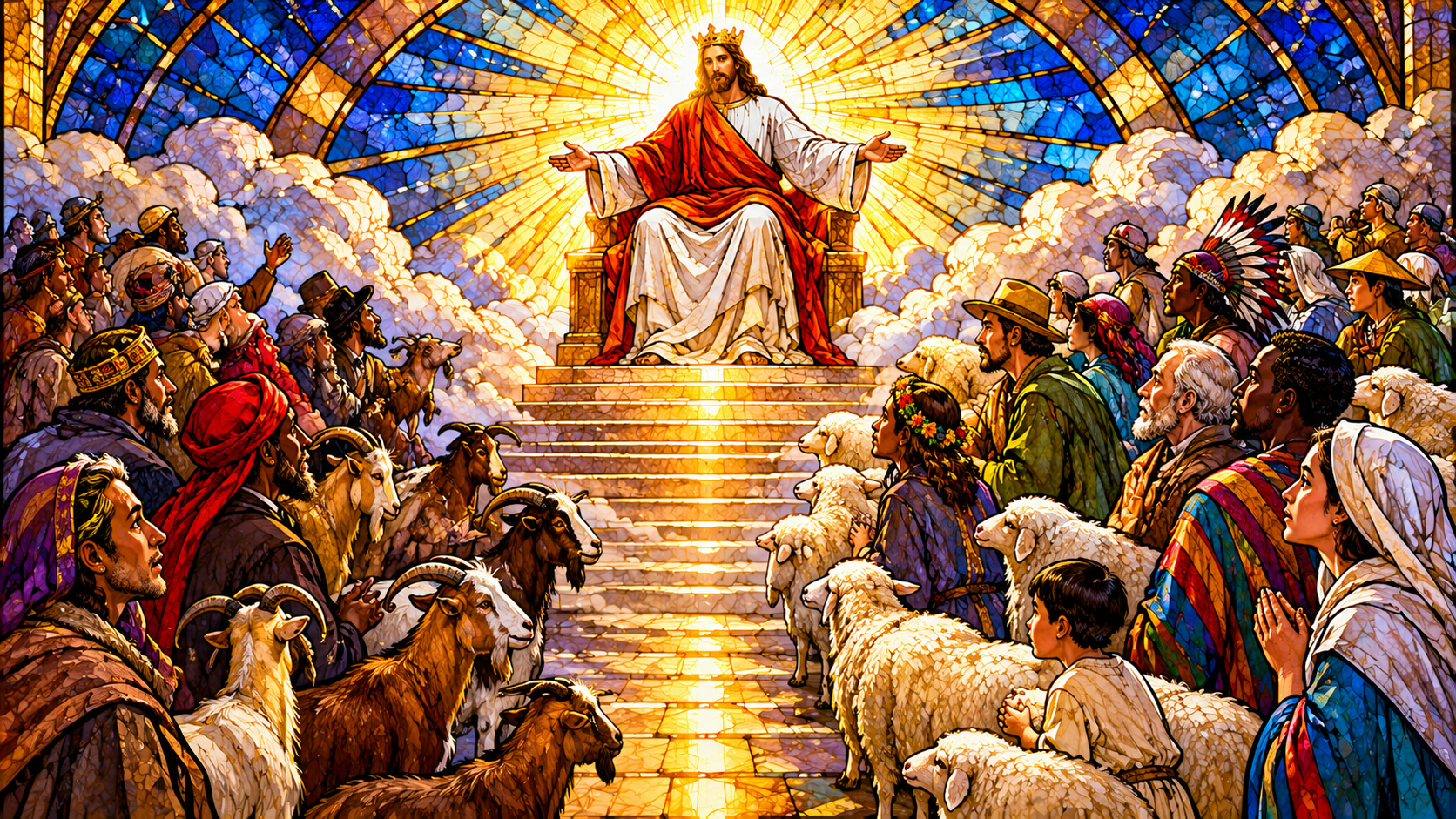
When the Son of Man comes in his glory, and all the angels with him, then he will sit on his glorious throne. Before him will be gathered all the nations, and he will separate people one from another as a shepherd separates the sheep from the goats. And he will place the sheep on his right, but the goats on the left. Then the King will say to those on his right, ‘Come, you who are blessed by my Father, inherit the kingdom prepared for you from the foundation of the world. For I was hungry and you gave me food, I was thirsty and you gave me drink, I was a stranger and you welcomed me, I was naked and you clothed me, I was sick and you visited me, I was in prison and you came to me.’ Then the righteous will answer him, saying, ‘Lord, when did we see you hungry and feed you, or thirsty and give you drink? And when did we see you a stranger and welcome you, or naked and clothe you? And when did we see you sick or in prison and visit you?’ And the King will answer them, ‘Truly, I say to you, as you did it to one of the least of these my brothers, you did it to me.’
“Then he will say to those on his left, ‘Depart from me, you cursed, into the eternal fire prepared for the devil and his angels. For I was hungry and you gave me no food, I was thirsty and you gave me no drink, I was a stranger and you did not welcome me, naked and you did not clothe me, sick and in prison and you did not visit me.’ Then they also will answer, saying, ‘Lord, when did we see you hungry or thirsty or a stranger or naked or sick or in prison, and did not minister to you?’ Then he will answer them, saying, ‘Truly, I say to you, as you did not do it to one of the least of these, you did not do it to me.’ And these will go away into eternal punishment, but the righteous into eternal life.”
Grace to you and peace from God our Father and our Lord and Saviour Jesus Christ!
To listen the sermon PRESS THE ORANGE BUTTON!
We, Lutheran Christians, sometimes struggle with what Matthew records in this passage. What exactly is Jesus teaching here? At first glance, it may seem that when the Son of God returns in glory, sits on His throne, and gathers all nations before Him, we will be judged according to… what we have done. According to our works!
Jesus will say to the righteous: “Come, you who are blessed by my Father, inherit the kingdom prepared for you from the foundation of the world!” Why? Because you did all these things: fed the hungry, gave drink to the thirsty, welcomed strangers, clothed the naked, visited the sick and cared for those in prison. Because you did these things!
But isn’t this confusing? Doesn’t it seem to contradict what the Holy Spirit reveals elsewhere in Scripture? “We know that a person is not justified by works of the law but through faith in Jesus Christ… because by works of the law no one will be justified” (Galatians 2:16).
Or: “For by grace you have been saved through faith. And this is not your own doing; it is the gift of God, not a result of works, so that no one may boast” (Ephesians 2:8–9). Isn’t this abundantly clear? By faith alone, by grace alone! Not by our works or anything we have done, but by what Jesus has done.
And yet here we are, listening to Jesus say: “Because you did all these things…” This is not only confusing; it can be disturbing. The questions arise – how do you know that you have done enough? Perhaps some people have, but what about you?
Have you fed, clothed, visited and cared for others as much as you could have? Really? If our eternal destiny depends on how we have lived, then where is the assurance of salvation? Where is the good news? The comfort and assurance are gone, what remains are doubt and uncertainty. What will happen with me on that day?
Sometimes we try to get around this puzzling passage by saying that saving faith is simply assumed. The good works Jesus describes are the fruits of saving faith. Yes, we are saved by faith, but genuine faith is living, active and serving. That is certainly true. But it may not be what Jesus is emphasizing here.
Thanks be to God for faithful and gifted teachers of Scripture who remind us to read God’s Word carefully and allow Scripture to interpret Scripture! Let me suggest that what Jesus is teaching here may be even more challenging for us than we might have thought. I would also suggest that the key to understanding this passage lies in identifying those whom Jesus calls “these my brothers.”
Remember His words: “Truly, I say to you, as you did it to one of the least of these my brothers, you did it to me.” If we understand whom Jesus means by “my brothers,” we will also begin to understand what He is teaching us.
Let’s picture this magnificent scene: “When the Son of Man comes in his glory, and all the angels with him, then he will sit on his glorious throne. Before him will be gathered all the nations, he will separate people one from another as a shepherd separates the sheep from the goats. He will place the sheep on his right, but the goats on the left.”
Then the King will say to those on His right: “Come, you who are blessed by my Father, inherit the kingdom prepared for you from the foundation of the world.” And to those on His left: “Depart from me, you cursed, into the eternal fire prepared for the devil and his angels.” And what makes the difference? “As you did it to one of the least of these my brothers, you did it to me.” Or, on the other hand: “As you did not do it to one of the least of these, you did not do it to me.”
Try to picture this! There are sheep on the right and goats on the left. And then there are “these my brothers.” Jesus addresses both groups and explains that how they treated His brothers determines their ultimate destination: either “the kingdom prepared for you from the foundation of the world” or “the eternal fire prepared for the devil and his angels.”
Who are these brothers of Jesus? Why does our attitude toward them matter so much? Throughout Matthew’s Gospel, the term “brothers” is used in reference to Jesus’ disciples. The first thing we can establish is that Jesus is speaking about His own people, His disciples. This means we should not conclude from this passage that everyone who cares for the poor, clothes the naked or visits the sick will automatically enter God’s kingdom. As Christians, we certainly are called to do these things and more, but not to earn salvation. We do them in response to the gift of salvation. Loving our neighbours.
But then, Jesus cannot simply be referring to all Christians, because all Christians belong among the sheep on His right, the blessed ones. So, who, then, are these brothers? What Jesus says elsewhere helps us to find the answer.
After His resurrection, He told the women: “Go and tell my brothers to go to Galilee, and there they will see me” (Matthew 28:10). So Jesus’ brothers include the apostles, whom He sent to make disciples of all nations. It was in the context of sending His chosen disciples with the Gospel that Jesus said: “Whoever receives you receives me, and whoever receives me receives him who sent me” (Matthew 10:40). Or, as we heard today: “As you did it to one of these my brothers, you did it to me.”
In other words, when Jesus speaks of “these my brothers,” He is referring to those whom He calls and sends with the particular mission of proclaiming the Good News of His resurrection. This includes pastors and laypeople, men and women, who carry this Gospel to others. These are the brothers Jesus is talking about.
Whoever receives them receives Jesus. And whoever receives Jesus receives the Father who sent Him. The whole Trinity comes and makes His home with such a person. This means that on the Last Day, all people will be separated according to how they received those who proclaimed the Gospel of God’s Kingdom to them. That makes sense!
Some will have welcomed and cared for God’s messengers because they believed the message they proclaimed. Through that message, they were welcomed into fellowship with the Father and the Son. Saved. Others will have ignored or mistreated Jesus’ messengers because they rejected their message. And in rejecting the messengers, they rejected the Son, the Father and the gift of salvation. It is that simple!
So, what does this mean for all of us? There are two things I would like to highlight: God’s grace and our responsibility. First, grace. Our God is gracious. He has not given up on us. He continues to speak to us and call us to Himself. He patiently waits for us, creates new hearts within us, builds us up, feeds us and strengthens us.
Week after week, He forgives our sins and assures us of His faithfulness. He is patient and gentle. He desires that everyone takes their place at His eternal feast and that every room in His Father’s house be filled. He does not want empty seats or empty rooms!
How does He do this? Sure, He does speak to us through His written Word. But mainly He speaks to us through human voices. He uses His people to bring us His life-giving Word and Spirit. He sends apostles and evangelists, pastors and teachers, laymen and laywomen to bring us His royal gifts: new life, eternal life with Him. This is how He works. Even today. This is how He keeps us in the true faith. And that brings us to the second point: our responsibility. How do we respond? The way we treat those who bring us God’s message is the way we treat the holy One who sent them. Once we understand this, I hope the Spirit moves us to support and care for God’s messengers. Not because of their personal qualities, or rather lack of them, but because called and sent by God, they bring us the words of Christ, the words of life. Because through His messengers Christ brings us eternal life. This is what Jesus is teaching us: how sweet and overwhelming His grace is and also the extraordinary importance of His very ordinary messengers. But there is more. Something particularly challenging for those who are sent with the Gospel.
Two things again: responsibility and grace. First, responsibility. Those whom Jesus has called to this particular ministry, He has sent with God’s message. That means we are sent to bring Christ, not ourselves. We are sent to preach and teach what Jesus has commanded, not what we or our listeners might prefer. We are called to be faithful.
That is not always easy. It may come at a cost. It often does. Old Adam in me really doesn’t like this part! In today’s Gospel, Jesus tells us that His messengers may be hungry and thirsty, in need, exhausted, imprisoned or even put to death. That’s part of the calling.
The most beautiful message in the world will be rejected by the world. Even those who receive the message may fail to care for Christ’s messengers. Bringing life to others will mean dying to ourselves. And for some, it may literally mean dying. Not exactly the most appealing job advertisement, what you think? But there is also abundant grace.
It is Jesus Himself, together with the Father and the Holy Spirit, who promises to be with His messengers wherever they go, whatever they face and whatever they have to endure. Besides, He is not asking us to repeat what He Himself has already done for us.
It was Jesus who was tempted and went hungry in the wilderness. For us. It was Jesus who took upon Himself all our sicknesses. For us. Jesus was the stranger who was rejected. For us. He was arrested, imprisoned, beaten and mocked. For us. He was stripped and nailed naked to the cross. He thirsted. His life was violently taken from Him. For you.
It was Jesus who drank the full cup of God’s wrath. In our place. He does not ask us to do the same. Today, He sends His messengers with the Good News of His victory over all His enemies. Jesus’ message is simple: “Tell everyone: I did this for you!” And today, Jesus Himself comes to us through His servants, welcoming us into fellowship with God all those who receive His message and who care for His messengers.
This is what Jesus is teaching us through His picture of the Last Day. Your eternal destiny does not depend on how well you have lived your lives. Even as we are to strive to love our neighbours with all the talents entrusted to us. No excuses! However, your eternal destiny depends on how you have received and treasured Jesus’ life-giving message. We are simply called to receive with joy and gratitude what He freely offers.
I pray that when that glorious Day comes, when we are gathered before Jesus’ throne with countless multitudes, you all will hear His voice welcoming you: “Come, you who are blessed by my Father, inherit the kingdom prepared for you from the foundation of the world, for you welcomed and cared for these my brothers!”
Amen.

