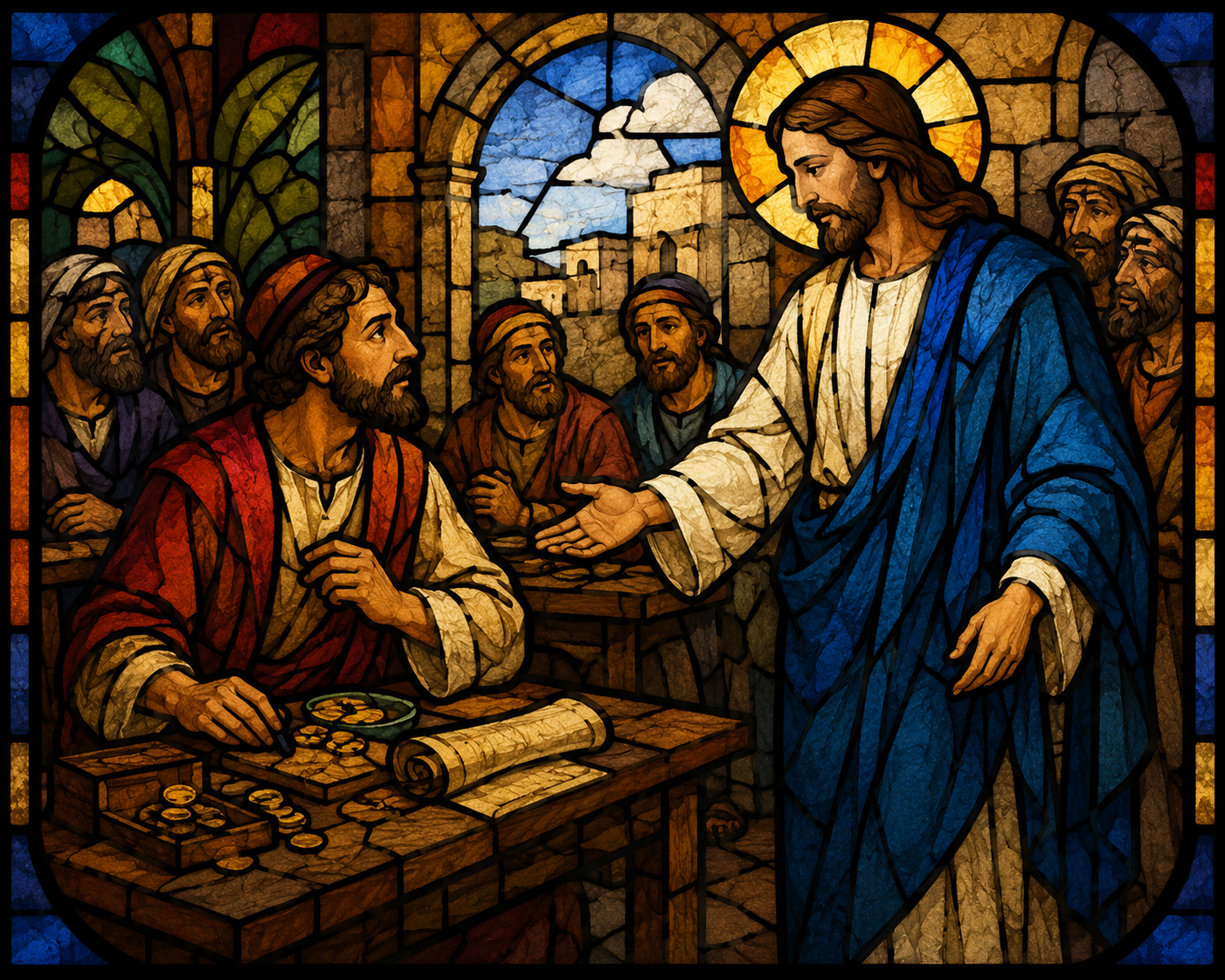
As Jesus passed on from there, he saw a man called Matthew sitting at the tax booth, and he said to him, “Follow me.” And he rose and followed him.
And as Jesus reclined at table in the house, behold, many tax collectors and sinners came and were reclining with Jesus and his disciples. And when the Pharisees saw this, they said to his disciples, “Why does your teacher eat with tax collectors and sinners?” But when he heard it, he said, “Those who are well have no need of a physician, but those who are sick. Go and learn what this means: ‘I desire mercy and not sacrifice.’ For I came not to call the righteous, but sinners.”
Grace, mercy and peace from God our Father and our Lord and Saviour Jesus Christ!
To listen the sermon PRESS THE ORANGE BUTTON!
“As the Father has sent me, even so I am sending you.” You and you and you, and each one of us. The Church. The body of Christ. As the Father sent Jesus in His Great Rescue Mission to transfer those under the power of the devil into the Kingdom of God, so Jesus now continues the same mission through us.
As Jesus went instructed by His Father, we could learn a few things from how He went about engaging with us. Today’s Gospel reading is a good place to start, and it raises quite a few interesting questions. Such as.
Who does Jesus call? With whom does He engage? Who responds to His call? But then also, how does Jesus see those whom He calls? How should we see others when we extend to them Jesus’ invitation?
And, also, what happens when Jesus calls someone and they follow Him? What happens next? And finally, a tricky one, how much, how far, how seriously do we need to follow Jesus? Who does Jesus call, how does He see us, what happens when we respond and how far do we need to follow Him?
First, who does Jesus call to follow Him? The short answer is – everyone. We learn from the Gospel accounts how Jesus engaged with all kinds of people from the cream of society to those on the fringes. He reached out to everyone, and He went wherever He was invited. No one was too highly seated for Jesus not to reach them, and no one was too lowly for Jesus not to bend down to them.
They all were plagued by sin. They all were victims of fear of death. They all were slaves to idols and under the power of the ruler of this age. They all were in desperate need for deliverance and healing, and the Good Doctor came to them all.
It was up to those Jesus engaged with to recognize their need for what He offered. Otherwise, if you don’t know that you are terminally ill, you are not concerned about getting the saving medicine. The Son of God may offer you the medicine of eternal life, and you may have no interest in it.
Salvation may be so close, but because of the hardness of our hearts, also so far. As it is also with the people in Oshawa; the new life-giving Gospel is preached right here, in their midst, but if they don’t recognize their need…
Who did respond to Jesus’ call? Again, we could say that there were very different people, beginning with Jewish leaders and politicians and rich people, such as Joseph of Arimathea and Nicodemus, as Joanna, the wife of Chuza, Herod’s household manager, down to people whom Jesus had liberated from demon possession.
But it seems that people especially receptive to Jesus’ message were those on the fringes of society, such as tax collectors, sinners and prostitutes. Those for whom it was obvious that they needed a doctor. Those who were despised and ignored by the religious people of that day. How is it today? Perhaps, there is a lesson for us to learn.
Next, how does Jesus see those He calls? How do we see people around us? We usually see them as they are. At this moment of their lives. We can’t see much more, can we? Perhaps, we may learn their past and that may shape our perception. Anyhow, we like those who are like us, we are quite happy to engage with them, and we don’t like very much those who are different, for whom sin is written all over their faces.
Jesus sees us very differently. He sees us as what He can create us to be. As what He knows He will create us to be. For example, we would see a tax collector named Matthew. From what we know from history, he was probably quite a well-off guy.
It was a common practice to auction the rights to gather taxes and whoever would make the highest bid, would get the contract. Then that person would work hard to squeeze as much money as possible from those who, in fact, did all the work. That is why the tax collectors were so hated. That’s how everyone would see Matthew, rich and greedy, ready to sell out his own people.
How did Jesus see Matthew? He sees Matthew as one in need of salvation, in need to be freed from his captivity to sin. He sees tax collector Matthew as one of His closest disciples. He sees Matthew as the author of the Gospel according to Matthew.
He sees Matthew as His committed follower who will give up His life for the Gospel, just as Jesus did give His life for him. He sees Matthew as the one whose written account will speak the Gospel of forgiveness and life to millions and millions through millennia and to all nations. And ultimately, He sees Matthew as someone rejoicing in New Heavens and New Earth in communion with the Risen Jesus forever. He sees Matthew as what He will create Him to be.
How does Jesus see you? The same way as Matthew. Not as you are today. Not as you have been in the past. He sees you as into what He will make you. As someone to whom He wants to give countless opportunities to pass on the blessings that He will keep giving you. As someone who He knows will keep blessing many others in the power of the Holy Spirit. And ultimately, He sees you as someone in a new and resurrected body, like Him, rejoicing and reigning with the Son of God and all His saints forever and ever. That is how He sees you. That is how we should see everyone else. Not as they are now. Be they high up or at the very bottom.
May the Lord help us to envision everyone transformed by the Holy Spirit, renewed and restored, with incredible potential for goodness, faithfulness, self-sacrifice, with infinite opportunities to extend God’s blessings to countless others if only we let our God to use us. There are no limits in what the Triune God can do through us. That is as true for you as it is for everyone else.
Next question was – what happens when Jesus calls? That is a bit scary. He calls us to follow Him. Which means to give up our old life, our old allegiances, our old self and to follow Him. To fear, love and trust Him above everything else.
In other words, He invites us to die to self. But He also gives us a new life. So much larger, so much more exciting, adventurous, beautiful and joyful life. Life where every day we spend in His company, surrounded by His saints, where we are privileged to take part in the business of His Kingdom, sharing His gifts and blessings.
When He calls us, when we learn who He is and what He has done for us, for us! when we learn how He sees us, how hopeful He is for us, what incredible future He has prepared for us, His unfathomable grace transforms us.
We can’t but respond by throwing ourselves at Jesus’ feet. Remember what happened with Matthew? He was overwhelmed. He wanted all His friends to meet this Jesus. Sure, they were a dubious bunch, and he wanted them to experience what He had just experienced. Such unconditional acceptance and welcome, such affection and grace. With Jesus calling him, Matthew’s previous life had to give. He couldn’t go back. He was a new man, now enlisted among the servants of God Most High.
Luke tells the same story about another tax collector Zacchaeus. He too was caught off guard. He knew who he was. He knew what he had done. He knew how everyone else saw him. As a greedy extortionist. He couldn’t imagine that Jesus would pay any attention to someone like him.
But Jesus found him and said the words he would never forget. “Zacchaeus [Jesus knew his name!] hurry and come down, for I must stay at your house today.” [Luke 19:5] Zacchaeus was transformed. He couldn’t but respond to such overwhelming grace: “Lord, the half of my goods I give to the poor. And if I have defrauded anyone of anything, I restore it fourfold.” [Luke 19:8]
And, sure, not everyone responded. Not all tax collectors became Jesus’ disciples, not all sinners were looking for God’s forgiveness, not all prostitutes became faithful wives and pillars of community. But Jesus doesn’t hold back His grace as we cautiously may.
He pours it over every human being. You have experienced it. Some in a more dramatic and emotional manner, some in less. But when that happens, we want to follow this Lord, we want to be with Him wherever He goes. To experience His presence.
“He who is forgiven little, loves little,” as Jesus says elsewhere. May the Holy Spirit help you to see and experience how much you have been forgiven so that you can love much as a forgiven sinner, found, called and embraced by your Redeemer Jesus.
Finally, wrapping our mediation up, we could reflect on a question which in my experience comes up often in different forms. I would argue that that is not a good question for Christians to ask. In fact, it is a wrong question. This is the question.
How far do I need to follow Jesus? How much do I need to die to myself? How much do I need to give away? Can you spot what is wrong with these types of questions? Those kinds of questions people ask when they want to be good on their own.
When they see their relationship with God as based on what they do and how well they do it? That is what the Pharisees asked: “How much do I need to serve? How much do I need to do? Give me the criteria and I will work to make it happen. Then I will be good in God’s eyes. Not like those who have failed to live that way.”
Those are the questions asked by people who still haven’t been hit by the destructive power of God’s Law. “You sinner, through in through, in your heart, thoughts, words and actions, in what you do wrong and in what you fail to do, you want to know what needs to be done to be enough? Look at the Cross of Christ! That is what needs to be done for you to be good. And the Good News is… that it is done. It is finished!”
Jesus says: “I desire mercy and not sacrifice.” I don’t need your sin soiled attempts to show how good you are, I want you to rejoice in my mercy and to extend it to everyone else. Jesus wants you. God the Father wants you. God the Holy Spirit wants you. Why? To share with you everything they have. To make you like Jesus. To reign together forever. The Triune God wants you. For He knows what He can create you to be.
We don’t need to ask questions about how much we need to… you don’t need to earn, or merit, or give a certain amount, or a certain time, or a certain percentage. None of that! As a Christian, you need to look at your life in a completely different way.
Instead of asking questions to God, you need to answer His question to you. This is the question: “How much do you want to be a blessing to others, how much do you want God to use you for the sake of others, how much joy and blessed adventures do you want to experience in your life working together with the Triune God?”
He has called you, by name, He has gifted you, He is willing to give you countless opportunities to bless others with the Gospel and your service. The sky’s the limit. If only we are willing to let Him use us. As Matthew did, as other apostles did. As Paul the apostle wrote: “It is no longer I who live, but Christ who lives in me.” [Gal 2:20]
I pray, may Jesus keep calling us and through us many and many others, especially those who are in desperate need for this Heavenly Doctor. May we see everyone as Jesus sees them, as their beautiful and majestic future selves, may we follow Lord Jesus as Matthew did and may the Triune God bless others through us as He did through that greedy tax collector Matthew whose Gospel account we heard today. Amen.

