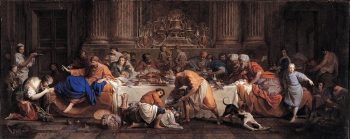
“One Sabbath, when he went to dine at the house of a ruler of the Pharisees, they were watching him carefully. And behold, there was a man before him who had dropsy. And Jesus responded to the lawyers and Pharisees, saying, “Is it lawful to heal on the Sabbath, or not?”But they remained silent. Then he took him and healed him and sent him away. And he said to them, “Which of you, having a son or an ox that has fallen into a well on a Sabbath day, will not immediately pull him out?” And they could not reply to these things.
Now he told a parable to those who were invited, when he noticed how they chose the places of honor, saying to them, “When you are invited by someone to a wedding feast, do not sit down in a place of honor, lest someone more distinguished than you be invited by him,and he who invited you both will come and say to you, ‘Give your place to this person,’ and then you will begin with shame to take the lowest place. But when you are invited, go and sit in the lowest place, so that when your host comes he may say to you, ‘Friend, move up higher.’ Then you will be honored in the presence of all who sit at table with you.
For everyone who exalts himself will be humbled, and he who humbles himself will be exalted.”
He said also to the man who had invited him, “When you give a dinner or a banquet, do not invite your friends or your brothers or your relatives or rich neighbors, lest they also invite you in return and you be repaid. But when you give a feast, invite the poor, the crippled, the lame, the blind, and you will be blessed, because they cannot repay you. For you will be repaid at the resurrection of the just.”
Grace, mercy and peace from God our Father and our Lord and Savior Jesus Christ!
To listen the sermon PRESS THE ORANGE BUTTON!
“For everyone who exalts himself will be humbled, and he who humbles himself will be exalted.” That is how Jesus ends the parable that He told to His host and his guests.This is what we will focus on in today’s mediation.
What is Jesus teaching us? He is telling us this parable, which is easy to relate to. We can easily imagine ourselves in a situation like that, perhaps, we may have even been in a situation like that.
There is a public event happening, Jesus in this parable speaks about a wedding feast, and, surely, there are some seats which are the seats of honor. Who gets to sit in those seats of honor? Significant people.
It tells something about you if you get to sit in those seats. It means that you matter, that you are somebody. Who wouldn’t want that recognition?! And some may want to pursue this recognition and spotlight by promoting themselves.
But trying to exalt themselves, to show how significant, how irreplaceable, how worthy they are. And perhaps, we should not say that some do that, but that from time to time we all may be doing just that.
But Jesus says: “Don’t do it! It may end badly. Imagine if you take that seat, if you push yourself forward, but then you are asked to give that place to someone else. That would be so awkward. Rather sit at the back, and if then you are invited to come forward, then you will be honored, then you will be exalted.”
What is Jesus teaching us? It may appear that He is sharing with us a useful tip for how to pursue honor and recognition in a clever way. “Don’t promote yourself, rather humble yourself, and wait for others to promote you, that works much better.”
Of course, it does. But is that what Jesus is teaching? How to be clever and how to promote ourselves by showing to others how humble we are? Is Jesus instructing us to use the humble facade to deceive others and push ourselves higher up? Of course, not!
Then what is He teaching? Remember, as Luke clarifies, Jesus tells a parable. Parable is a way of speaking where you use one illustration to explain something about another matter. What is that another matter that Jesus is teaching us with this parable?
Something of a very radical nature. Jesus is teaching us how different Christian way of life is, how differently Christians see and perceive this world and ourselves in it, compared with how the world functions and what it values.
Let’s see. We know how this world functions and what it values. Three big ones are – wealth and power and fame. But why these? Why do we pursue wealth and power and fame? Because of what they seemingly give to us. What is it?
They give us the sense that there is a significance to our lives, that we do matter, that we are somebody, that we have made it, that we are recognized, that we can feel good enough about ourselves and secure about our future.
But notice this! All those are immaterial longings. Yes, immaterial.
Living in this world we are led to believe that if we play by the rules of this world, if we sacrifice our time and energy and sometimes so much more – our relationships, other people, our health, our integrity, our very lives in pursuit of wealth and power and fame, then eventually those immaterial longings of our hearts will be satisfied.
The day when we get there… And we tend to believe it. And if we realize that probably we will never make it, that we are not competitive enough, then we just need to settle for a life where we are nobodies, and our existence really doesn’t matter.
Now Jesus says: “Don’t be fooled, don’t play that game!” But… what can we do, we all long for those immaterial things. All human beings have those longings. They are universal. And that’s fine. Jesus is not saying that our longings are wrong.
They are built into us – longings for meaning, for significance, for recognition – we are created to have them satisfied. What Jesus is saying is that playing according to the rules of this fallen world will not deliver what we long for.
What is He suggesting then? He is not just suggesting. He is calling you; He is inviting you to live in a different world, in a radically different world. Not in a world where rules are defined by sinful human beings and where our achievements and merits have the last word to say in what our worth is.
He invites you to an entirely different world. What is it? Jesus hints at it as He concluded that parable: “For everyone who exalts himself will be humbled, and he who humbles himself will be exalted.” “Will be humbled… will be exalted.” This grammatical form is called divine passive. What does that mean?
It means that the Triune God is the one who acts, He is the One who humbles and who exalts us. He is in control of everything. Jesus calls you into that world, into His Kingdom, where the Triune God rules how He wills and where all those deep longings of our hearts are satisfied by no one else, but by the very God who made us.
When we are brought into His Kingdom, He doesn’t treat us according to our merits. He gives us what we truly need and long for as His gifts, as undeserved and unmerited gifts. In Christ’s Kingdom your significance and worth do not depend on and are not judged by some societal standards – wealth or fame or power – but by how the Triune God sees you and by how significant you are in His eyes.
And He assures you: “I created you, I knitted you together in your mother’s womb, I made you in my image, which means, as my representative, as my emissary, as my steward of this creation, in my book are written all the days of your life. This is true!”
In Christ’s Kingdom you are recognized, exalted and honored, not by fallen human beings, but by the Son of God, Jesus, as He brings you into His family. In that Kingdom God the Father looks at you in delight and says: “You are my beloved child, with you I am well pleased!” This is what Jesus is teaching with this parable.
And when we hear the Son of God revealing and then reminding of these divine realities to us, this is when we are made humble. Our Creator values us, even as we have turned away from Him and our sin has tainted every square inch of our being.
He doesn’t leave us, He comes to redeem us, He reveals just how significant you are in His eyes – for the Son of God was willing to suffer separation from His eternal Father so that only He could bring you back into that divine fellowship with Himself.
When the Spirit convinces us of these divine realities, we are made humble. For we recognize that there is nothing that we haven’t received. Our lives, our families, our abilities and talents, education, people and opportunities in our lives, all are given. As is your significance, your worth and your recognition in the eyes of our God. Gifts.
The more we have received, the humbler we should be, the less we should be worrying about exalting ourselves. It applies especially to those gifts that the world so highly values. If the Lord in His wisdom has given you wealth, or power or fame, it is not to exalt ourselves by means of those earthly perishables. There is no need for that.
Having them can’t make you more significant or not having them less significant, for what really matters, and matters eternally, is how the Triune God sees you. Whatever else we have received in this world is given not to exalt ourselves, but to serve our neighbors in the likeness of God, as the Son of God serves us.
Whatever banquets we may be invited to attend in this world, and whatever seats of honor may be in those public events, none of them comes even close to the grandeur and splendor of the wedding feast of the Lamb and His Bride the Church.
Because this is an eternal, divine banquet that will go on forever. In this banquet the very Host, the Eternal Son of God Himself has honored you by personally inviting you, and here He Himself exalts you by serving you: “Come and eat, come and drink, this is my body, this is my blood, given and shed for you, for the forgiveness of all your sins!”
We can’t just choose to be humble. We can’t change our hearts. It doesn’t work that way. That would be only an act. But when Jesus comes, when He speaks to us and reveals to us the truth, He sets us free from this fallen world, and He transfers us into His Kingdom, where He Himself serves you His greatest gifts.
In His Kingdom, He restores you to be who you are created to be, a very special person in the eyes of the Triune God. His child, adopted into His divine family through your Baptism, destined for eternal glory in New Heavens and New Earth. That’s you!
When we know this, when the Spirit convinces us of this divine truth, the reality of God’s grace and generosity transforms us and humbles us. We are free to rejoice in who we are created and redeemed to be; we are free to serve others for we don’t need to exalt ourselves. It is done already. By our God.
Don’t forget it. Be grateful. Strive to serve others as Jesus serves you.
Amen.
 The Kingdom at Grace Lutheran Oshawa