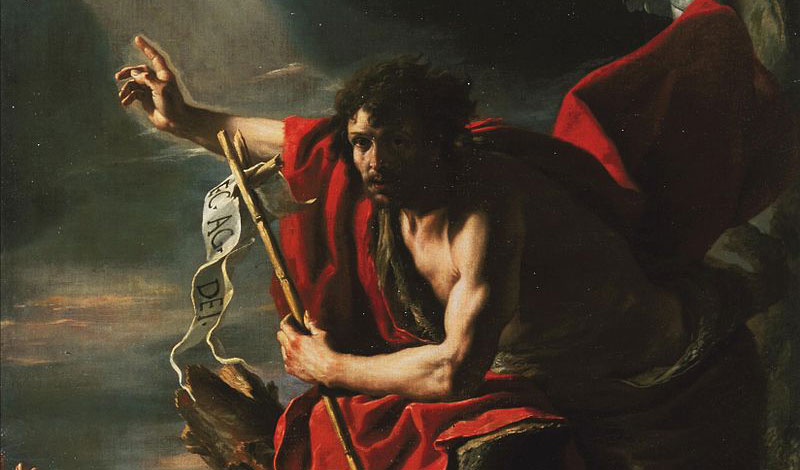
“He said therefore to the crowds that came out to be baptized by him, “You brood of vipers! Who warned you to flee from the wrath to come? Bear fruits in keeping with repentance. And do not begin to say to yourselves, ‘We have Abraham as our father.’ For I tell you, God is able from these stones to raise up children for Abraham. Even now the axe is laid to the root of the trees. Every tree therefore that does not bear good fruit is cut down and thrown into the fire.”
And the crowds asked him, “What then shall we do?” And he answered them, “Whoever has two tunics is to share with him who has none, and whoever has food is to do likewise.” Tax collectors also came to be baptized and said to him, “Teacher, what shall we do?” And he said to them, “Collect no more than you are authorized to do.” Soldiers also asked him, “And we, what shall we do?” And he said to them, “Do not extort money from anyone by threats or by false accusation, and be content with your wages.”
As the people were in expectation, and all were questioning in their hearts concerning John, whether he might be the Christ, John answered them all, saying, “I baptize you with water, but he who is mightier than I is coming, the strap of whose sandals I am not worthy to untie. He will baptize you with the Holy Spirit and fire. His winnowing fork is in his hand, to clear his threshing floor and to gather the wheat into his barn, but the chaff he will burn with unquenchable fire.”
So with many other exhortations he preached good news to the people.”
Grace to you and peace from God our Father and our Lord and Saviour Jesus Christ!
Let me ask you: “What kind of tree are you? What kind of fruit do you bear?” What do I mean with these questions? Last Sunday we meditated upon the question “how to prepare for the return of our Lord Jesus Christ?” And the answer that the Holy Spirit Himself gives to us through His faithful servants is – repentance.
And as we reflected, godly repentance is a big thing. It is actually so big that there is no way we can do it on our own. Remember the words of Isaiah the prophet: “Every valley shall be filled, and every mountain and hill shall be made low, and the crooked shall become straight, and the rough places shall become level ways.”
He was talking about our hearts. About how difficult it is to prepare our hearts so that we could wait for the coming of the Lord with joyful hope. It is like filling all the valleys and making every mountain and every hill low. Who could do that?!
It is our gracious God who Himself speaks to us, who sends His Spirit to dwell in us, who prepares our hearts for His coming. It is His work. Today we heard the next part of John the Baptist’s message and it reveals even more about the gift of repentance.
Namely, true repentance bears fruits. Let’s see what all of this means for us.
John “said therefore to the crowds that came out to be baptized by him, “You brood of vipers! Who warned you to flee from the wrath to come? […] And do not begin to say to yourselves, ‘We have Abraham as our father.’ For I tell you, God is able from these stones to raise up children for Abraham.”
What was going on? Why was John so harsh? “You brood of vipers!” Why to call those people who came to him deadly snakes? What was so deadly about them? Remember, John was preaching a baptism of repentance for the forgiveness of sin.
“Come, repent, be baptized and receive the forgiveness of sins!” Sounds like a good deal for everyone who has a conscience and a slightest notion of God as our Judge Eternal. “I come, I get baptized and I receive the forgiveness of sins. Great!”
Why was John so harsh? Because He was dealing with this rather widespread notion about how we could interact with God. Without true repentance. We do something and then God does something for us. We do the ritual and God gives us His gifts.
There are different variations of the same false idea. One extreme would be those who say that they know that they are saved by grace alone, not by what they do, so… they don’t need to do anything; neither repentance is needed, nor the fruits of repentance.
For others it manifests as the idea that we only need to do the right rituals, and if we have done them, we are okay. Get baptized, get confirmed, perhaps call in on big Christian festivals like Christmas or Easter. Again, no repentance, no fruits needed.
Yet for others it may be about their status, their connections. “Our forefathers came on that ship. Our ancestors built this or that church. Our family have been members of this or that church for X generations. Why would we need to repent?”
Yet for others it may be about their merits, their works of service: “We have done this or that in the church for years, without us nothing would have happened, everything keeps together only because of us. What to repent of?!”
That is a good choice of words – “brood of vipers.” For such an attitude before God is deadly. It is deadly for those people themselves. And it is deadly for Christian community. It misrepresents Christian faith, the Gospel, it handicaps the ministry of congregation, it poisons relationships within congregation, it quenches the Spirit.
Instead, this is what the Lord expects from us: “Bear fruits in keeping with repentance. […] For even now the axe is laid to the root of the trees. Every tree therefore that does not bear good fruit is cut down and thrown into the fire.”
Bear fruits in keeping with repentance, or else… True, godly repentance is God’s work, and it is more transforming than we may think at first. Yes, it is our Triune God Himself who brings us to repentance as He speaks to us.
But God’s speaking is not like our speaking. When we speak there are vibrations of the air which we hear as sounds. Or those may be marks of the paper that we perceive as symbols. Sure, we get their meaning, by hearing and by reading.
When God speaks, so much more happens. The Word of God is never alone. He is always accompanied by the Spirit of God. They both work together hand in hand. Or rather as two hands of God the Father with which He embraces us.
When the Triune God speaks to you, His Word and His Spirit come to you, indwell in you and begin the work of new creation. They make a new heart in you. They make you a new creation, our God Himself renews and transforms you.
When God brings us to repentance, when He comforts us with His Good News of sins forgiven and relationships restored, His words are not weak or idle. They are powerful and active; they make you into a new tree, a different tree, a good and fruitful tree.
As Jesus said: “Either make the tree good and its fruit good, or make the tree bad and its fruit bad.” (Matt 12:33) “For no good tree bears bad fruit, nor again does a bad tree bear good fruit.” (Luke 6:43-45) Or as Dr Martin Luther said: “Yes, we are saved by faith alone, but the saving faith is never alone.” It is always accompanied by the good fruits of repentance.
This is where we come to another problem. We are so afraid to expect the fruits of repentance. We are so afraid to ask for commitment, so afraid to urge people to do good works. We are afraid that such expectations will drive people away.
That the bar will be set too high, that we can be accused of being the people of law and not the people of the Gospel. For people of the Gospel wouldn’t expect anything from anyone, right? They just love and accept and period. At least some say so.
But… John did expect fruits of repentance, as did Jesus, as did Paul and every other apostle. Remember, our God has not only saved us, rescued us and redeemed us from, but also for. For what? For new life in Christ. We are “created in Christ Jesus for good works, which God prepared beforehand, that we should walk in them.” (Eph 2:10)
If we don’t teach this, if we don’t expect this from ourselves, from one another and every disciple of Christ, we rob ourselves of great joy. Our God has been so gracious, He has done and does so much for us, and our good works are our way to thank Him, to please Him, to express our gratitude, and also to rejoice in this new life in Christ.
If we don’t teach and expect this, we have misrepresented what the true faith is, we have only given a pale picture of what it means to follow Jesus. Then we are the brood of vipers, deadly for Christian community, with the axe already laid at our roots.
“Every tree therefore that does not bear good fruit is cut down and thrown into the fire.” Why wouldn’t we strive to bear good fruits, why wouldn’t we urge and help others to bear good fruit? Why wouldn’t we teach and model joy-filled Christian life?
But what are those good fruits of repentance, we may wonder? Luke gives as a few examples. The crowds asked John, “What then shall we do?” He answered them, “Whoever has two tunics is to share with him who has none, and whoever has food is to do likewise.” To the tax collectors he said: “Collect no more than you are authorized to do.” To the soldiers: “Do not extort money from anyone by threats or by false accusation, and be content with your wages.”
Briefly summarizing. For one, the Spirit through John instructs us to have a certain attitude towards our assets, to be faithful stewards of God’s gifts. Those who have more than they need, need to share with those who don’t have enough. Almost certainly most of us have more than we need, we can share with those who don’t have.
Either in our neighbourhood, or in those places where the needs are the greatest. Notice, John exhorted those who had two tunics, I wonder what would he have said to those who have houses, cars and savings and assets, and more and more. I guess, that’s up to us to figure out how to be fruitful.
The other instruction of John has to do with our occupations, or we can say with our professional callings. Yes, true. Christians often think that the only fruits that count are those we bear doing something for the Church in our congregations.
But listen to what John says! We bear fruits when we do our jobs well, when we see them as our service not only to our neighbours, but also to our generous Lord, and when we pour out our hearts to do our jobs well. Keep this in mind!
“So with many other exhortations he [John the Baptist] preached good news to the people.” Indeed, with many exhortations he preached the good news. There are so many exhortations in the New Testament. These are not separate topics. The good news on the one hand, and the exhortations on another.
No, they come together, they are a part and parcel of the same message, of the same new life that our gracious Lord grants you. He brings you to repentance; He proclaims you the Good News of forgiveness and He exhorts you to live bearing good fruits. And what a good and joyful life it is!
So, what kind of tree are you, Brothers and Sisters? What kind of fruit do you bear? I pray that each one of you would be abundant in your harvest, that your branches would hang low to the ground from the superabundance of fruits and that many are blessed by the fruits of your repentance that our Lord Jesus produces through you.
Be a good tree. Bear much fruit. Be blessed! Amen.
 The Kingdom at Grace Lutheran Oshawa