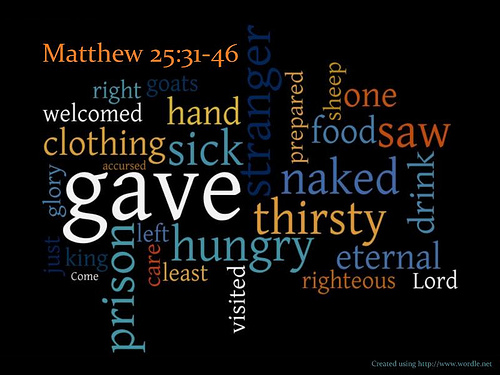
When the Son of Man comes in his glory, and all the angels with him, then he will sit on his glorious throne. Before him will be gathered all the nations, and he will separate people one from another as a shepherd separates the sheep from the goats. And he will place the sheep on his right, but the goats on the left. Then the King will say to those on his right, ‘Come, you who are blessed by my Father, inherit the kingdom prepared for you from the foundation of the world. For I was hungry and you gave me food, I was thirsty and you gave me drink, I was a stranger and you welcomed me, I was naked and you clothed me, I was sick and you visited me, I was in prison and you came to me.’ Then the righteous will answer him, saying, ‘Lord, when did we see you hungry and feed you, or thirsty and give you drink? And when did we see you a stranger and welcome you, or naked and clothe you? And when did we see you sick or in prison and visit you?’ And the King will answer them, ‘Truly, I say to you, as you did it to one of the least of these my brothers, you did it to me.’
“Then he will say to those on his left, ‘Depart from me, you cursed, into the eternal fire prepared for the devil and his angels. For I was hungry and you gave me no food, I was thirsty and you gave me no drink, I was a stranger and you did not welcome me, naked and you did not clothe me, sick and in prison and you did not visit me.’ Then they also will answer, saying, ‘Lord, when did we see you hungry or thirsty or a stranger or naked or sick or in prison, and did not minister to you?’ Then he will answer them, saying, ‘Truly, I say to you, as you did not do it to one of the least of these, you did not do it to me.’ And these will go away into eternal punishment, but the righteous into eternal life.”
Grace to you and peace from God our Father and our Lord and Saviour Jesus Christ!
Great reading we have for our reflections today. Quite well-known as well. And also quite challenging, I would add. We often don’t know what to do with it, what to make of it. What is Jesus actually teaching us here?
Now, at first glance it seems that Jesus here is teaching that on the Last Day, when the Son of God returns in His glory and all nations are gathered before His throne, we will be judged based on … on what we did. Based on our good works!
Jesus will say to the righteous: “Come and receive the Kingdom that was prepared for you from the foundation of the world!” Why? Because you did all those things – feeding the hungry, giving drink to the thirsty, welcoming the strangers, clothing the naked, visiting the sick, attending to the imprisoned. Because you did this!
All those good works! Why would this be confusing? Because it seems contrary to what the Holy Spirit reveals to us elsewhere. “We know that a person is not justified by works of the law but through faith in Jesus Christ… because by works of the law no one will be justified.” (Galatians 2:16) Or: “For by grace you have been saved through faith. And this is not your own doing; it is the gift of God, not a result of works, so that no one may boast.” (Ephesians 2:8-9)
Aren’t these verses abundantly clear? By faith alone, by grace alone! Not by works, not by what we have done, but by what Jesus has done. Praise the Lord! But then we come to today’s reading. “Because you did all these things…”.
It is not only confusing; it is actually depressing. The monster of uncertainty raises its head in our hearts. “How do you know that you are good enough? Have you done enough? Some may have indeed done enough, but you?! Have you done all those feedings and clothing and visiting and caring? As much as you could? Really?”
If our eternal fate depends on how we have lived, the assurance of our salvation is gone, there really is no more good news, the peace is gone, only doubts, uncertainty and fears remain. You will stand before the throne of holy God and will be judged!
Sometimes we try to explain these verses by saying that saving faith is assumed. That all those good works that Jesus lists here are manifested fruits of our saving faith. That, yes, we are saved by faith, but that true faith is living and active and serving.
It is not wrong, but that may not be what Jesus is teaching us here. Thanks be to God, for faithful and gifted teachers and doctors of the Scripture, who remind us to read the Word of God closely, who teach us that the Scripture helps us to interpret Scripture.
Let me suggest that what Jesus is teaching here is much more confronting for you and for me than we would like it to be. Let me also suggest that the key that unlocks this passage is found in the identity of “these my brothers”.
Remember what Jesus said: “Truly, I say to you, as you did it to one of the least of these my brothers, you did it to me.” If we can understand who Jesus is referring to, who are these brothers of Jesus, we will also understand what He is teaching us.
Now, let’s try to picture this magnificent event. “When the Son of Man comes in his glory, and all the angels with him, then he will sit on his glorious throne. Before him will be gathered all the nations, and he will separate people one from another as a shepherd separates the sheep from the goats. And he will place the sheep on his right, but the goats on the left.”
Then the King will say to those on his right, ‘Come, you who are blessed by my Father, inherit the kingdom prepared for you from the foundation of the world.” Then he will say to those on his left, ‘Depart from me, you cursed, into the eternal fire prepared for the devil and his angels.”
And the difference will be: “As you did it to one of the least of these my brothers, you did it to me.” Or: “As you did NOT do it to one of the least of these, you did not do it to me.” Try to picture this! There are the sheep on the right and there are the goats on the left. And then there are “these my brothers”.
Jesus is engaging with those on the right and with those on the left and explaining that the way we treat “these His brothers”, that is what determines our ultimate destination, which will be either “the kingdom prepared for you from the foundation of the world”, or “the eternal fire prepared for the devil and his angels”.
Who are “these Jesus’ brothers” and why does our attitude toward them determine our eternal fate? Let’s see! Whenever Matthew in his Gospel account mentions “brothers”, he is referring to the disciples of Jesus, he is never referring to all people or nations.
So, the first thing we know for sure is that when Jesus speaks about “these my brothers” He is referring to Christians, to His disciples. That much is clear. Which means that we shouldn’t conclude from this text that whoever cares for the poor, clothes the naked, or visits the sick will automatically enter the kingdom of God.
As Christians we certainly are to do all those things and more, but not as the way of salvation, but as our response to the gift of salvation. But then, Jesus can’t be referring to all Christians either, for all Christians are those on the right, the blessed, those who have done all those good things for Jesus’ brothers. Then who are these brothers?
What Jesus says elsewhere helps us to clarify it. This is what He said to the women when He met them after His resurrection: “Go and tell my brothers to go to Galilee, and there they will see me.” (Mt 28:10)
So, yes, Jesus’ brothers began with the apostles who were sent to make disciples from all nations. It was in that context of sending His chosen disciples with the Gospel message when Jesus said: “Whoever receives you [messengers of the Gospel] receives me, and whoever receives me receives him who sent me.” (Mt 10:40) Or as we had it today: “As you did it to one of these my brothers, you did it to me.”
Otherwise put, when Jesus speaks about “these my brothers”, He speaks about all those, pastors and laypeople including, men and women, who are called and sent with the specific mission, to share the Good News of Jesus’ resurrection.
They are “these my brothers” that Jesus is referring to. When they bring the Good News, whoever receives them, receives Jesus, and whoever receives Jesus, receives God the Father, and the whole Trinity comes and makes home with such a person.
Which means that on the Last Day all people will be divided based on how they received those who proclaimed them the Gospel of the reign of God. Some will have responded and cared for God’s missionaries because they believe the message proclaimed and thus, they were welcomed in the fellowships with the Father and the Son. Others will have ignored or even mistreated Jesus’ messengers, for they rejected their message, and so they rejected God the Son and God the Father and the gift of salvations. This tells us how closely Jesus identifies, how profoundly He is with His chosen messengers. If you are one of them, it is through you that Jesus builds and expands His Kingdom. What a privilege it is!
So, what does this mean for us all? Two things to highlight. Grace and responsibility. Our God is gracious. He hasn’t given up on us. He keeps speaking to us, waiting for us, He keeps calling us to Himself, He creates in us new hearts, He builds us up, He feeds and strengthens us. He keeps sending to us His messengers.
Every week He forgives us our sins and assures us of His commitment. He is patient and gentle. He desires that everyone can take their seat in His eternal feast and that all rooms in His Father’s house are filled. He doesn’t like empty seats or empty rooms.
And how does He do that? Sure, He speaks through His written Word, but mainly He speaks to us with human voice. He uses human beings to bring His life-giving Word and His Spirit to us. He uses apostles and evangelists, pastors and teachers, laymen and laywomen to bring us His royal gifts, this new life, eternal life with Him.
That is how He works. Still today. This is how He keeps us in true faith. Which leads to the next point. Responsibility. How do we respond? The way we treat those who bring us God’s message, that is how we treat the holy One who sends them.
Once we realize that, I hope, we are moved to support and care for God’s messengers, not because of their personal qualities or lack of them, but because they bring us the words of Christ, they bring us the words of life, they bring us the very life itself.
This is what Jesus is teaching to all of us. The sweetness of His grace and the extraordinary nature of His very ordinary messengers. But there is more. Something rather challenging for those who are sent with the Gospel message.
Two things. Responsibility and grace. First, responsibility. We are sent with God’s message. Which means, we are sent to bring Christ, not ourselves. We are sent to preach and teach what Jesus commanded, not what we or our listeners prefer.
We are expected to be faithful. That may not be easy. That may cost. And honestly, my flesh really doesn’t like this part. In our today’s reading Jesus says that His messengers may be hungry and thirsty, in need, exhausted, imprisoned, or even lose their lives.
That’s a part of the deal. The most beautiful message will be rejected by the world. Even those who accept the message may be negligent to the messengers. Bringing life to others will mean dying for ourselves. And for some it may literally mean – dying. Not the most appealing job advertisement! But there is also so much grace.
Abundant grace. It is Jesus Himself, and God the Father and the Holy Spirit who promises to be with His messengers. Wherever they go. Whatever they face. Whatever they have to experience. And by the way, He isn’t asking us to repeat what He Himself did for us. It was Jesus who was tempted and hungered in the desert.
It was Jesus who took all our sickness. It was Jesus who was a stranger and was rejected. It was Jesus who was arrested, imprisoned, beaten and mocked. It was Jesus who was crucified naked to the cross. It was Jesus who thirsted. It was Him whose life was violently taken.
It was Jesus who drank the full cup of God’s wrath. In our place. He doesn’t ask us to do the same. Today He sends His messengers with the Good News of His triumph over all His enemies: “Tell everyone I did it for them!” Today He Himself comes to us through His servants to welcome into the divine fellowship those who gladly receive His message and care for His messengers.
This is what Jesus is teaching us with His portrayal of the Last Day. Our eternal fate doesn’t depend on how we have lived this life. It depends on how we have received and appreciated His life-giving message. It’s still Jesus who does the heavy lifting, not us. It’s all Him.
We are simply to receive what He offers us. I pray that when that glorious Day comes, when we are gathered before His throne, with all those countless multitudes, may you all hear His voice welcoming you: “Come, you who are blessed by my Father, inherit the kingdom prepared for you from the foundation of the world, for you were good to these my brothers!”
Amen.
 The Kingdom at Grace Lutheran Oshawa