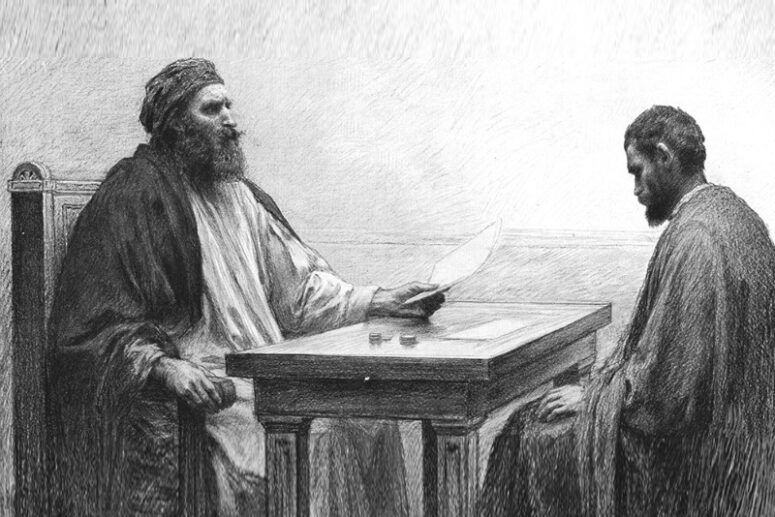
He also said to the disciples, “There was a rich man who had a manager, and charges were brought to him that this man was wasting his possessions. And he called him and said to him, “What is this that I hear about you? Turn in the account of your management, for you can no longer be manager.” And the manager said to himself, “What shall I do, since my master is taking the management away from me? I am not strong enough to dig, and I am ashamed to beg. I have decided what to do, so that when I am removed from management, people may receive me into their houses.” So, summoning his master’s debtors one by one, he said to the first, “How much do you owe my master?” He said, “A hundred measures of oil.” He said to him, “Take your bill, and sit down quickly and write fifty.” Then he said to another, “And how much do you owe?’ He said, ‘A hundred measuresof wheat.’ He said to him, ‘Take your bill, and write eighty.’ The master commended the dishonest manager for his shrewdness. For the sons of this world are more shrewd in dealing with their own generation than the sons of light.
And I tell you, make friends for yourselves by means of unrighteous wealth, so that when it fails they may receive you into the eternal dwellings. “One who is faithful in a very little is also faithful in much, and one who is dishonest in a very little is also dishonest in much. If then you have not been faithful in the unrighteous wealth, who will entrust to you the true riches? And if you have not been faithful in that which is another’s, who will give you that which is your own? No servant can serve two masters, for either he will hate the one and love the other, or he will be devoted to the one and despise the other. You cannot serve God and money.”
Grace to you and peace from God our Father and our Lord and Saviour Jesus Christ!
What if someone told you that the founder of Christianity, that Jesus of Nazareth, taught his disciples that it is quite okay to steal and to lie. And in case if they get caught, that may be fine to steal and lie even more and also to bribe their way out. What if they showed you where that is written black on white? How does that sound?
This is exactly what some of the early opponents of the Church claimed. They based their claim on the teaching of Jesus which we just heard today in our Gospel reading. They were referring to something that is, indeed, written in the Bible.
How do we respond? Is that true? Is that what Jesus was teaching? What would you say? How would you refute such accusation? Blessed we are to be members of the one, holy, Christian and apostolic Church!
For it is in this one, holy Christian Church, where the Holy Spirit has gathered the treasures of wisdom and understanding, far beyond what we could ever come up with on our own. Blessed we are to have access to these treasures!
To be able to stand on the shoulders of so many spiritual and intellectual giants who came before us, and to be able to enjoy the fruits of their labour! Blessed we are for without them passages like this could remain for us as veiled mysteries.
This is one strange teaching, and the distance in time and culture makes it more challenging for us to grasp what our good Lord Jesus is teaching us. But on the other hand, this is one of those precious gems of the Scripture.
There are a few stories like this one, which, if someone would turn them into a movie, they could make a really good suspense thriller. One where you unconsciously hold your breath waiting for what is to happen, where you want to stand up for the stress is just too much for you to sit still. Let’s see what “movie” Jesus is painting before our eyes and what He wants us to learn from it.
There was this very wealthy man, he owned vast lands, and he had his shares in so many businesses, that we could say that the economy of that whole region to great extent depended on him.
What does wealth and power do to people? Often, they bring out the worst in us. But not so in this case. This wealthy man was indeed highly respected and loved by the entire community. He was generous and gracious, wise and supportive.
He employed his wealth for the sake of his community and countless people benefited from his wise dealings. What happens if there is a wealthy tyrant, and then someone steals from them? People may even rejoice with a bit of envy: “Yes, he gets what he deserves!” Not with this man.
He was well regarded and when some members of the community found out that his own manager was stealing from him, they immediately brought this to his attention. They cared for his wellbeing as he cared for theirs.
His gracious character is even more highlighted when we see how he engages with his manager. He could have gotten him arrested, he could have locked him out of his office and, perhaps, he should have done both of these, but… no, he engages with his manager: “What is this that I hear about you?”
“Can you explain yourself?” There is silence. Not a word in response. The manager knows his master. He knows that he is gracious and generous a person, that is why he is still free, that is why they are still having that conversation.
He remains silent. That is his confession: “Yes, I am guilty.” He knows his master, he trusts that his confession will turn his master’s anger away, and it indeed does. We don’t know what may yet to come, but for now, he is simply asked: “Turn in the account of your management, for you can no longer be manager.”
And this is where the shrewdness of the manager begins to play out. But first, we needed to give him what is due, he takes an honest look at his options. “What shall I do, since my master is taking the management away from me? I am not strong enough to dig, and I am ashamed to beg.” He will lose the current position. Hopefully his gracious master doesn’t send him to jail. But the word about his affairs will get out and there is not a chance for him to get a similar position.
He could take up some manual labour, but he simply is not strong enough. He doesn’t want to join the ranks of beggars either, he is ashamed to consider such path. And then… the brilliant idea is born in his shrewd mind.
“I have decided what to do, so that when I am removed from management, people may receive me into their houses.” The idea if very bold and risky, it may work if everything comes together, but if not, then he is finished. Forever.
Because his master was so gracious, no one yet knows that he has been removed from his position. Everyone in the community still thinks he is the right-hand man of his rich master. So, he quickly and quietly rushes to execute his plan.
He summons his master’s debtors one of by one. One by one, so that there is no communication between them, so there is no suspicion, no unnecessary questions asked and the word about his actions doesn’t get back to his master.
“How much do you owe my master?” “A hundred measures of oil.” “Take your bill, and sit down quickly and write fifty.” “And how much do you owe?” “A hundred measures of wheat.” “Take your bill, and write eighty.”
These are huge numbers. If we converted them to our currency, we are talking here about tens and even hundreds of thousands of dollars. These are big deals. Serious business. What is going on, we may wonder? What is the manager’s play?
As the business partners of the rich man still think that the manager is acting in his name, they gladly accept the new terms for their arrangements. They are overjoyed for the generous act of the rich man, and, of course, they recognize that it was the good manager who had put a good word for them. And… they are in his debt.
They are brought in one by one. Tension is enormous. What if the master finds out? What if the manager is caught wasting his master’s future gains? Can the manager make it happen? Every minute the dangerous plan may turn into a disaster. Will there be the knock at the door, guards walking in… and everything is over?
Time is ticking. Finally… The last debtor is sent away. The manager folds the account book and heads to the master’s office. He turns in the accounts and… the moment of truth. Did his plan actually work? And … “The master commended the dishonest manager for his shrewdness.” What on earth is going on?!
The masters commended him?! For lying and stealing and then lying and stealing more? Not at all! But what then? In the 1st century Palestine, the community was everything. Good news, bad new, everything had to be shared.
And suddenly, there is this amazing act of grace. The rich man has done something incredible; he has just gifted not one, not two, but all his debtors with this amazing gift. He has reduced their financial commitments for some even by half!
The good news spread like wildfire. One after another his debtors share the news about the rich man’s generosity, about his care for the community. The financial burden is made so much lighter, what a relief! It cries out for celebration.
The celebration praising and honouring the generous benefactor of the community, the man, the myth, the legend! When the manager brings back his accounts, the news about the joy and excitement in the community may have already reached the rich man. And this is where we see the shrewdness of the manager.
This is why he was commended. He had set up a perfect trap for the master, betting everything on the master’s gracious character. Now the master needs to choose; he could, of course, tell everyone that the manager has tricked them all.
That there are no new arrangements, that there is no reason for celebration, that they still owe as much as they did in the morning. He can disrupt their festive rejoicing and rob them of the gift they all are celebrating, or…
… or he can choose to bear the cost himself, and let the community rejoice and celebrate. The manager knew his master. He knew what he would do. He knew that he would rather choose to bear whatever the cost, instead of burdening or saddening his community.
And he was right. The master commended him. Not for stealing, not for lying, not for scheming and plotting and bribing, not for wasting his possessions, but – because the manager had understood his situation rightly – that he couldn’t be saved by trying to justify himself.
And he had understood the gracious character of his master – that his only chance was hoping and relying on the grace and mercy of his master. This is what Jesus is teaching us! To know the gracious character of our God and to trust in his mercy.
To know our Triune God. The time is coming when the accounts of our lives will be opened for auditing. The accounts where every smallest detail is carefully recorded. Not only our actions, but also our words and thoughts and our secret desires.
Who can we rely on that day? Can we try and negotiate our way out? Or should we recognize that our only hope is trusting in our Master’s grace? By the way, it’s not that hard to imagine that everything could be recorded.
The digital age has taught us that much. Think about this, for example. Every website you have ever visited, every picture you have looked at online, every video you have watched, every comment you have made online, all of that is recorded and stored somewhere. Nothing is forgotten.
Can we stand if even those records are open? What when the accounts of our entire lives are made open? “If you, O Lord, should mark iniquities, O Lord, who could stand? But with you there is forgiveness, that you may be feared.” (Ps 130:3-4)
How blessed we are that we have our gracious and generous Master Jesus Christ! He is ready to pay whatever the cost, so that only he can spare those, whom He loves and cherishes more than His own life.
Dear Brothers and Sisters in Christ, we can safely bring our accounts to our Master Jesus in full assurance that He in the most gracious and generous Master, that He will take care of them, that He will bear the cost that we have incurred to Him.
“Against you, you only, have I sinned and done what is evil in your sight.” (Psalm 51:4) The cost for our betrayals, our unfaithfulness, our pride, our foolishness, our disobedience, our lying and steeling and murdering and coveting, the cost is indeed very high, the very life of the Son of God.
And… He bears the cost, so that we can go free. You are fee. Whatever is recorded in the account of your life. Whatever crocked it may be, whatever great your debt. Whatever you may have done wrong. It is all taken care of. You are free to wait for the day when you will stand before your Master, free to wait for it without fear.
This is what our Master Jesus is teaching us.
May the Holy Spirit inspire us with the example of the shrewd manager, may He help us to rely on the grace of our Lord Jesus Christ, and on Him alone, not on our records, for this is what Jesus Himself invites us to do. When our accounts condemn us, let’s trust in the grace of our God.
And on that day when all the books are open, our gracious God and Master Jesus will commend you. He will. This is most certainly true.
Amen.
 The Kingdom at Grace Lutheran Oshawa